The concept of green building is not new in Alberta. The province has helped lead Canada’s green building industry since the 1970s. But how does that history translate into what’s being built today? To find out, we looked at public data on homes, larger buildings and voluntary certifications. We also looked at where the opportunities lie and where the Emissions-Neutral Building Information Exchange (ENBIX) fits in.
Alberta’s green building history
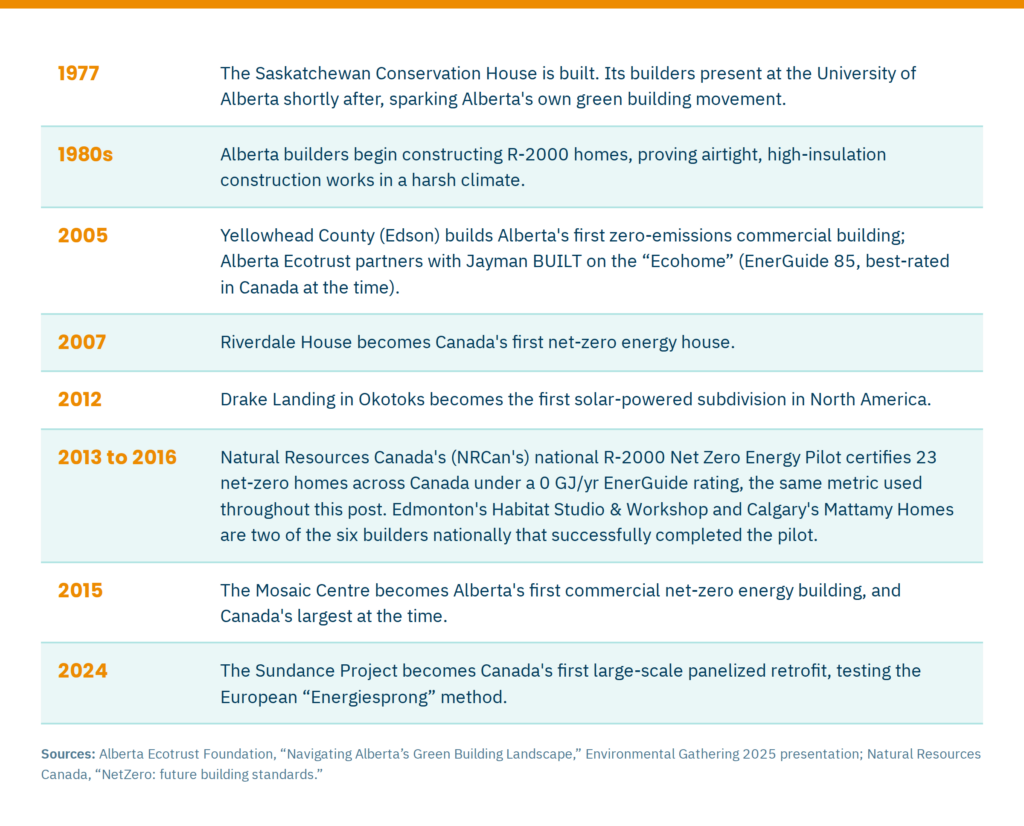
Alberta has played a larger role in the national green building movement than many people may realize. Here’s a short, non-exhaustive history:
What we’re measuring
A few terms appear throughout this post.
- “Green building” is the broad umbrella for buildings designed to reduce environmental impact.
- “High-performance” buildings use less energy than the building code requires.
- “Net-zero energy” buildings go further: they produce as much energy as they use, usually with on-site solar.
- “Net-zero ready” buildings meet the same efficiency standard, but don’t have on-site generation, such as solar, installed.
- “Emissions-neutral” is the broader goal ENBIX is working toward, where a building’s net greenhouse gas emissions are zero.
With those terms in mind, we looked at what each data source measures and which buildings it covers. This matters because a single-family home, a mid-rise apartment building and an office tower are governed by different parts of the building code and show up in entirely different datasets.
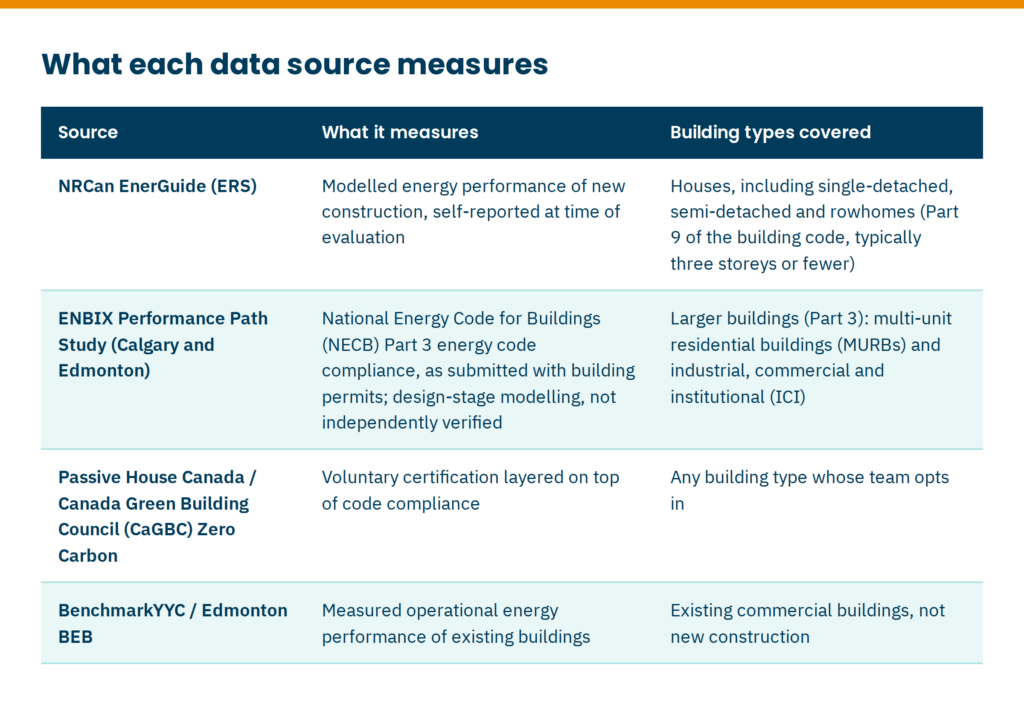
Drawing from several independent sources that each track a different part of the building landscape, here is what the public data shows:
Homes (Part 9)
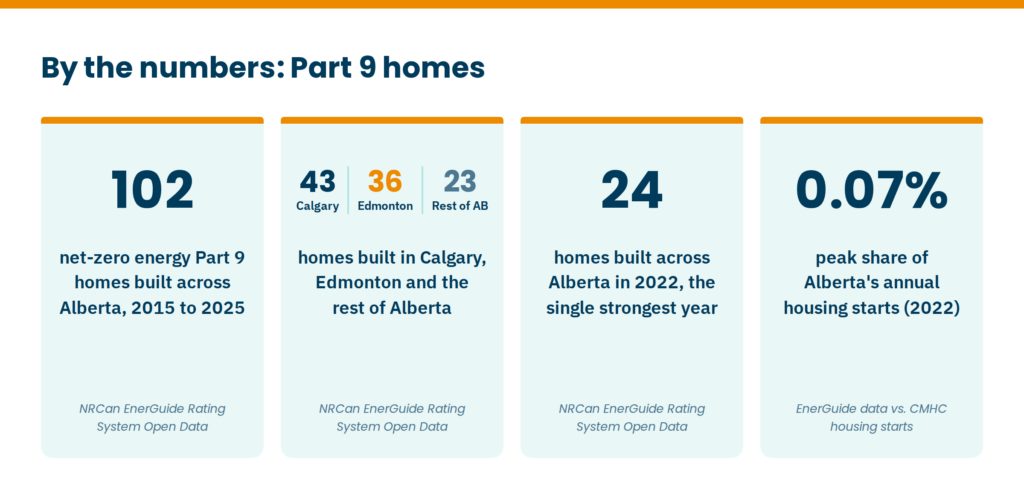
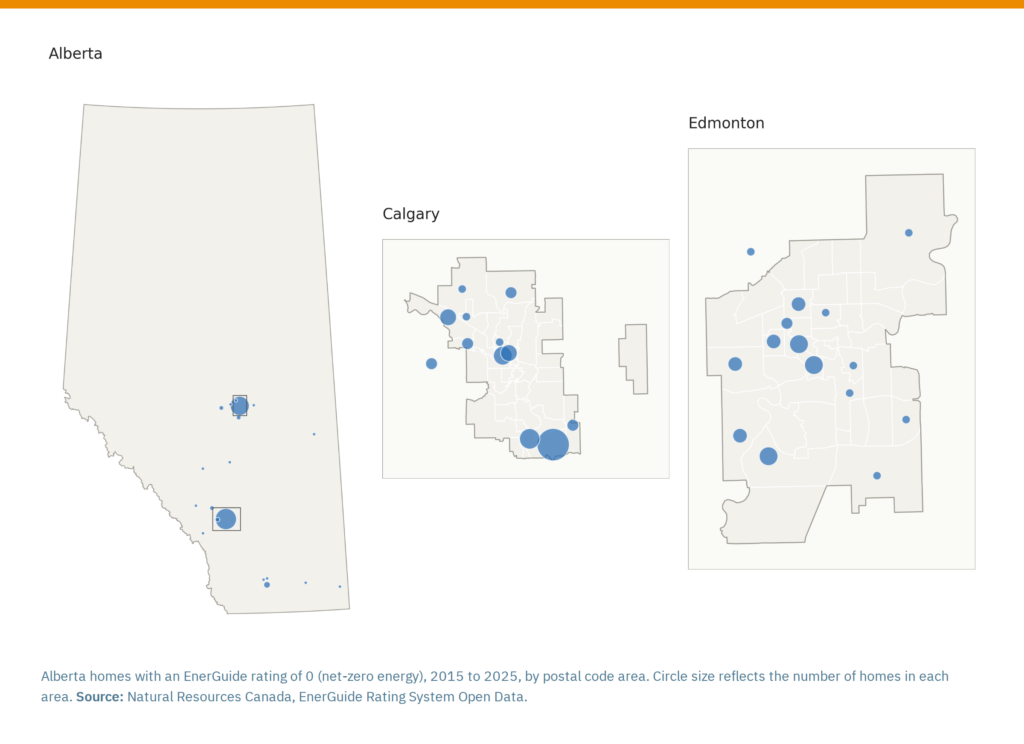
Natural Resources Canada’s EnerGuide Rating System Open Data is the most direct source for tracking net-zero energy homes. A home with an EnerGuide Rating System value of 0 consumes 0 gigajoules of energy in a year – net-zero. Between 2015 and 2025, 102 homes in Alberta received that rating: 43 in Calgary and 36 in Edmonton and 23 elsewhere in the province.
That is a small share of overall construction. Alberta had about 27,600 housing starts in 2017, 35,400 in 2022, and a record 54,858 in 2025 (Canadian Mortgage and Housing Corporation data). In no single year have net-zero energy homes made up more than about 0.07% of new homes, or roughly one in every 1,400.
The most net-zero energy homes were built in 2022, with 24 across the province. Housing starts were also up that year, so the increase could simply reflect more construction overall. But net-zero energy homes grew faster than the market. Their share of all housing starts nearly doubled, from about 0.036% in 2021 to 0.068% in 2022. The numbers then returned to 13 homes in 2023 and 11 in 2024, similar to the years before 2022.
Most of the 2022 increase happened in Calgary. Before then, Edmonton built more net-zero energy homes: 23 from 2018 to 2021, compared with Calgary’s 12. That reversed from 2022 to 2025, when Calgary built 31 and Edmonton built eight.
What might explain the timing?
These are possible explanations based on public information. We haven’t confirmed them with the builders involved.
Calgary’s 2022 increase coincides with a few developments that year:
- The 2020 National Building and Energy Codes were published in March 2022. They introduced tiered performance levels leading to net-zero ready construction, which may have encouraged builders to scale up.
- Jayman BUILT expanded its net-zero home line across its Calgary communities.
- Avalon Master Builder completed Calgary’s first net-zero townhome project.
Production builders like Jayman and Avalon add multiple homes a year, rather than one-off custom builds.
Edmonton’s earlier lead appears to reflect an earlier start:
- Landmark Homes began building net-zero homes in Edmonton in 2012 and had three net-zero communities in the city by 2015.
- Since 2017, the City of Edmonton has offered builders up to $200 per home to get an EnerGuide label and share it on the city’s Home Energy Map. As a result, Edmonton’s net-zero energy homes are likely more fully captured in the data than homes elsewhere in Alberta.
Why the numbers may undercount high-performing homes
But that count doesn’t tell the whole story. To get an EnerGuide rating of zero, a home needs on-site energy generation, usually solar panels, in place when it’s rated. A net-zero ready home is efficient enough for net-zero but doesn’t have solar installed yet. It won’t appear in these figures unless it’s rated again after the panels go in.
Other data points to this gap. EnerGuide records also show which of the building code’s five energy performance tiers a home meets. From 2021 to 2025, 369 Alberta homes reached Tier 4 or Tier 5, the two highest. In 2024, 163 homes reached these tiers, compared with 11 net-zero energy homes. Builder data points the same way: Alberta has 16 Canadian Home Builders’ Association (CHBA) Qualified Net Zero Builders, and some report building more net-zero homes on their own than the entire provincial EnerGuide total.
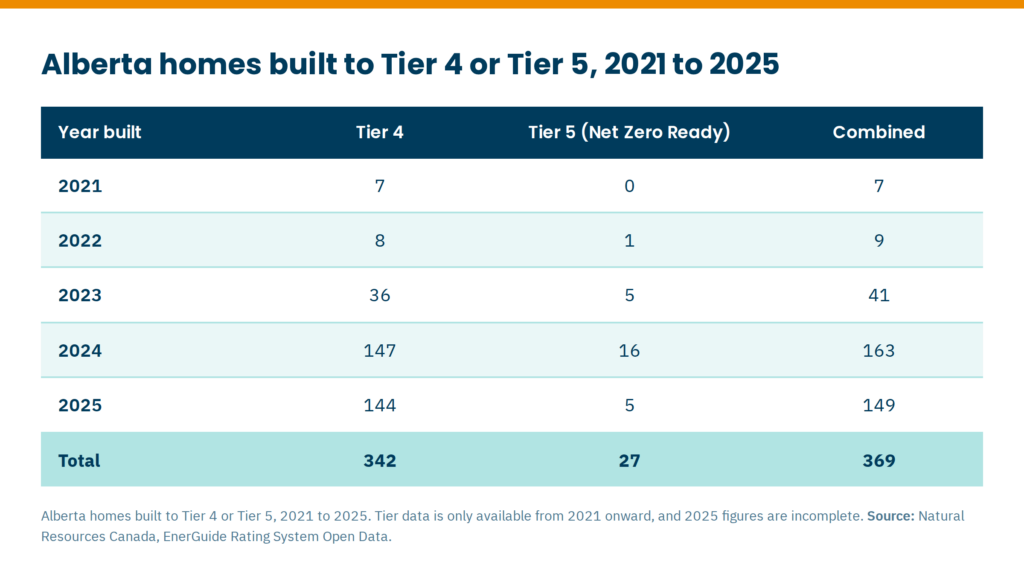
These figures likely undercount for two more reasons. EnerGuide ratings are voluntary, so homes that were never rated don’t appear in the data. Evaluations are also usually entered six to 18 months after a home is built, so counts for 2025, and to a lesser extent 2024, will likely rise. Even so, EnerGuide is the most detailed public source available for tracking home energy performance in Alberta.
Together, this suggests Alberta has more high-performing homes than the net-zero energy count alone shows.
Larger buildings (Part 3)
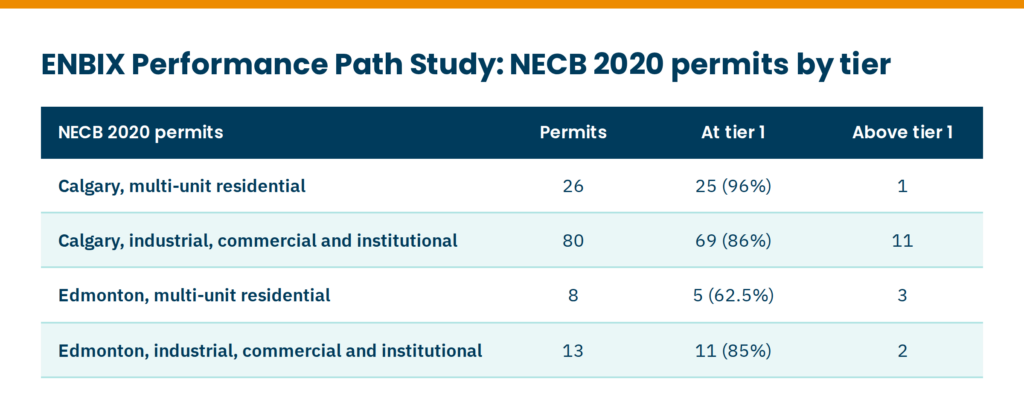
Larger buildings tell a similar story. Apartment and condo buildings, offices, retail, schools and warehouses fall under Part 3 of the building code and the NECB. ENBIX commissioned a review of every Part 3 building permit application in Calgary and Edmonton that showed code compliance through energy modelling, known as the performance path. This gives a more complete picture of these buildings than voluntary certification data alone.
The data comes from design-stage energy models submitted for permits. These models weren’t independently checked, and they show how efficient a building is designed to be, not how it performs once built.
The 2020 NECB introduced four energy performance tiers. Tier 1 is the code minimum, and Tier 4 performs about 60% better than a reference building, roughly equivalent to net-zero energy ready. Alberta currently only requires new construction to meet Tier 1 and hasn’t announced a timeline for higher tiers. The federal government’s goal is for provinces and territories to adopt net-zero energy ready building codes by 2030.
Unlike the EnerGuide ratings for homes, permit energy models don’t include on-site generation such as solar. So even a Tier 4 building is only net-zero ready. This data shows how efficient new buildings are designed to be, but not how many are net-zero.
The ENBIX Performance Path Study reviewed 127 Part 3 permits in Calgary and Edmonton under the 2020 NECB. Of these, 110 (87%) were at Tier 1, the code minimum. No privately developed project in either city went beyond Tier 2. The only permit to go further was a City of Calgary building that reached Tier 4.
Voluntary performance certification
On top of code requirements, some building teams choose to meet a higher standard through the following voluntary certifications:
- Passive House: Passive House Canada’s project database lists three registered or certified projects in Alberta. Passive House Alberta works to build awareness and training capacity in the province.
- LEED and Zero Carbon certification: CaGBC’s database lists more than 1,000 LEED-certified projects in Alberta. LEED rates broad sustainability performance, including energy, water, materials and indoor air quality, rather than emissions specifically. CaGBC’s Zero Carbon Building (ZCB) Standard has two certifications: ZCB-Design, which certifies that a building is designed for zero-carbon operation, and ZCB-Performance, which verifies zero-carbon operation. CaGBC lists 20 buildings in Alberta with ZCB certification, eight of them verified under ZCB-Performance, and 19 more projects registered and working toward it.
Where the opportunity lies
The big picture
Alberta has 102 net-zero energy Part 9 homes on record from 2015 to 2025, based on Natural Resources Canada’s EnerGuide data. From 2021 to 2025, 369 homes reached Tier 4 or Tier 5, the two highest energy performance tiers. In Calgary and Edmonton, 127 Part 3 building permits were reviewed under the 2020 energy code, and only one, in Calgary, went beyond Tier 2. Passive House Canada lists three Alberta projects and CaGBC lists 20 Alberta buildings with ZCB-Design certification and 8 of those are ZCB-Performance certified Across every dataset in this post, net-zero energy and high-performance buildings make up a small share of construction in Alberta. Alberta has a long history in energy-efficient building, and its builders have shown they can build high-performance buildings. But that ability alone hasn’t led to wide adoption. Without enough demand or financial incentive, most builders build to the code minimum. Gradually raising minimum energy performance requirements, in close consultation with the building industry, could move the market while limiting effects such as higher costs for buyers or construction delays.
Other work is also underway to help close the gap. Our Getting to Zero Research Project aims to fill some of the data gaps described in this post. It purchases performance data from designers, builders and developers on their low- and zero-emissions Part 9 buildings (single-family homes, MURBs and townhouses) to find out which strategies perform best, and will share those insights back with the industry. Training more energy advisors and Passive House consultants, and helping project teams through certification, can also increase the number of high-performance buildings. This work builds skills that Alberta’s trades and designers will need, whatever the pace of code changes.
For existing buildings, Alberta Ecotrust’s Retrofit Accelerator offers free coaching to help building owners and managers plan and complete deep retrofits. Since launching in September 2024, the program has worked with over 150 building owners, representing more than 1,800 buildings and completed over 450 desktop energy assessments. This suggests building owners are interested in this work when support is available.
This analysis is the starting point for ENBIX’s work: helping Alberta’s building industry share knowledge, build capacity and accelerate emissions-neutral construction and retrofits across the province. ENBIX’s programs aim to close the gap between the small number of high-performance buildings and the large majority built to Tier 1, alongside Alberta Ecotrust’s Retrofit Accelerator for existing buildings.
Interested in helping close that gap? Explore our programs:
- Industry Training in Alberta
- Knowledge Exchanges
- Alberta Ecotrust Retrofit Accelerator
- Alberta Ecotrust Getting to Zero Research Project
Resources referenced in the blog:
- NRCan EnerGuide (ERS)
- ENBIX Performance Path Study (Calgary and Edmonton)
- Passive House Canada / Canada Green Building Council (CaGBC) Zero Carbon
- BenchmarkYYC / Edmonton BEB