Alberta building owners often hesitate to pursue deep energy retrofits, citing high upfront costs and slow utility savings as common concerns. But looking only at utility savings can make a retrofit appear less worthwhile than it actually is. Conventional payback metrics often discourage investment rather than incentivize it.
For this case study, we explored a hypothetical 20,000-square-foot mixed-use commercial building in Edmonton. We compared two options: replacing aging heating equipment with similar technology or upgrading to a retrofit that includes solar panels and a ground-source heat pump. The retrofit option costs $855,000 more upfront. Over 20 years, it’s expected to save almost $400,000 in energy costs. That covers less than half the extra investment. On its own, this might make the retrofit look like a poor investment. But that perspective overlooks a broader picture.
Energy savings are only half the story
Looking at utility savings alone can lead building owners to the wrong conclusion. When you factor in capital stack like tax incentives, specialized financing, and grant funding, owners can move a project from a projected loss to a neutral or positive net present value. Achieving a neutral net present value means the project has effectively paid for itself while covering the cost of capital, demonstrating value that utility savings alone may not capture.
A common mistake in deep retrofit analysis is failing to account for the Business-as-Usual (BAU) baseline. BAU is not a zero-cost scenario. Electricity prices are projected to rise about 6.6 percent a year, and natural gas prices about 5.4 percent a year. Every building owner will eventually face a major cost to replace an aging boiler or heating system. In this case study, the $855,000 figure is the extra cost of choosing a deep retrofit over a standard replacement, not the total cost of upgrading the building.
Clean Energy Improvement Program (CEIP)
The Clean Energy Improvement Program (CEIP) offered by some Alberta municipalities, provides loans of up to $1 million for retrofit projects. It offers fixed interest rates for terms of up to 20 years, depending on how long the equipment is expected to last. Unlike traditional bank debt, CEIP is tied to the property rather than the owner and repaid through property taxes. If the building is sold before the loan is paid off, the remaining payments transfer to the new owner along with the upgraded equipment. This removes a common worry for building owners: taking on debt for a retrofit only to lose the benefit if the property sells sooner than planned.
Tax incentives
Federal tax incentives provide Alberta building owners with capital and depreciation benefits. In the case study, the Accelerated Investment Incentive (AII) generated $220,800 in tax savings by allowing eligible solar and ground source heat pump assets to be fully depreciated in the first year. This program only helps if the building owner has business income to offset.
The Clean Technology Investment Tax Credit (CT ITC) provided a refundable tax credit of $288,000, returning nearly one-third of eligible project costs to the owner. Unlike the AII, this credit doesn’t require the owner to owe taxes to receive it.
Figure 4 below illustrates how these financial tools improve project economics, reducing the remaining lifecycle cost beyond what energy savings alone can achieve.
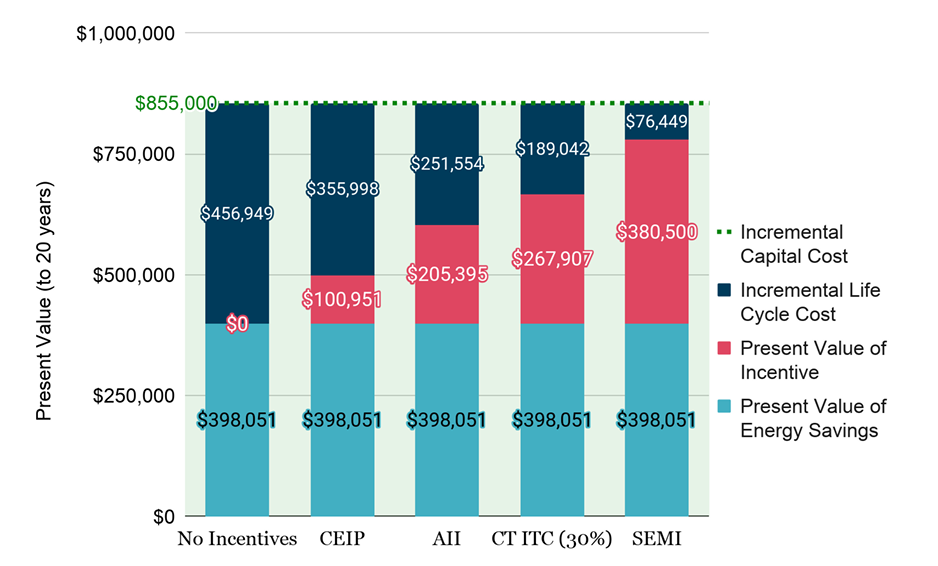
Figure 4. P.13 – “Financial Tools and Incentives Supporting Deep Retrofits in Alberta” – Incremental net present value of the retrofit upgrades when taking advantage of various financial tools and incentives
The power of combining financing
One of the most effective approaches to retrofit financing is combining multiple funding and financing sources. The case study found that no single incentive fully closed the financial gap, but combining programs had a much greater impact.
For example, the Strategic Energy Management for Industry (SEMI) program has provided up to $380,500 in funding for similar projects in the past. Combined with $995,000 in financing through the Clean Energy Improvement Program, the project achieves a neutral to positive net present value.
As shown in Figure 5, combining CEIP financing with SEMI funding effectively eliminates the remaining lifecycle cost that exists when incentives are evaluated individually. In the case study, the combined scenario slightly exceeded the incremental capital cost, resulting in a neutral-to-positive net present value over the 20-year analysis period. This illustrates why retrofit planning should focus on the full capital stack rather than utility savings alone.
Municipalities and renovators should be aware of the new Part 10: Alteration of Existing Buildings. While optional for provinces to adopt, it signals a broader move toward lifecycle-based regulation for existing buildings.
If adopted, Part 10 would require major component replacements in existing homes, such as HVAC systems, service water heating, or building envelope elements like windows and doors, to meet the energy-efficiency requirements of Part 9.36 for new construction. Basic maintenance and repairs are exempt, but full replacements can no longer be like-for-like if the old system did not meet modern energy standards.
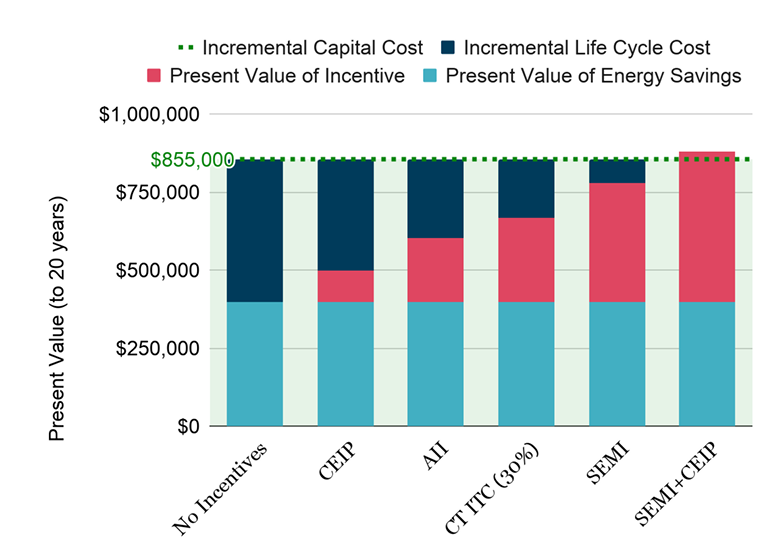
Figure 5. P. 15 “Financial Tools and Incentives Supporting Deep Retrofits in Alberta” Incremental net present value of the retrofit upgrades, including a scenario that combines financial tools and incentives.
Why heat pumps offer more value with cooling in mind
A ground-source heat pump can look expensive compared to a standard boiler, especially since the sample building in this case study didn’t need air conditioning. As a result, the analysis likely understates the value of a ground source heat pump system for many real-world commercial buildings.
As is highlighted in the Pembina Institute’s 2025 report Valuing Deep Retrofits, deep retrofits can improve air quality and temperature control, and reduce overall health care expenditures in residential buildings. While further research is underway to capture the health benefits and other non-energy benefits of retrofits in commercial buildings, this early work highlights how decisions about cooling and air quality can impact the overall business case.
For buildings that do need cooling, a heat pump system provides both heating and cooling in one, removing the need for a separate air conditioning system and its costs. As well, the underground piping used by the system can last well beyond the roughly 20-year life of the heat pump itself, adding value to the property long after the original investment is paid off.
Conclusion
- The case study demonstrates that energy savings alone tell only part of the retrofit value.
- Programs available in Alberta, like the Clean Energy Improvement Program, the Accelerated Investment Incentive and the Clean Technology Investment Tax Credit can make deep retrofits a stronger investment
- Building owners should evaluate retrofit projects from a full lifecycle and capital perspective rather than relying solely on energy savings estimates.
- Want more details on how we developed the sample project and estimated retrofit upgrade finances? Download the full case study to learn more.
This blog is the second in our Alberta Ecotrust Retrofit Learning Series. Each month, we publish a story about an innovative project or approach coming out of the Retrofit Accelerator. For the first blog in the series, see here.