Specialized heat pump training is essential for Alberta’s climate goals
The Northern Alberta Institute of Technology (NAIT), in partnership with Alberta Eoctrust, has piloted a specialized short course designed to give Heating Ventilation and Air Conditioning (HVAC) technicians the confidence to navigate an ever-changing industry.
This blog explores the course’s objectives and offerings, and why training like this is essential for reducing emissions from buildings across Alberta.
Note: This was a pilot course, and there will be future offerings, but the dates have not yet been determined.
Scaling climate solutions through education
Alberta Ecotrust, the parent organization of ENBIX, supports and scales up climate mitigation solutions, including reducing emissions from new and existing buildings across Alberta. We see improving the energy efficiency of our building stock, through retrofits and better performance in new buildings, as a key solution to reducing emissions.
A central component of improving building practices is increasing the building industry’s capacity to adopt and facilitate low-carbon and emissions-neutral technology. To support this, Alberta Ecotrust provided funding through our 2024 Climate Innovation Grant for NAIT’s Sustainable Heat-Pump Training Initiative. Through this initiative, NAIT developed EEBC120 – Cold Climate Air Source Heat Pumps Design and Installation, a course designed to increase industry professionals’ confidence in installing air-source heat pumps.
Going beyond standard heating and cooling
While heat pumps deliver both heating and cooling, this dual function creates new technical challenges. Not only do installers have to know best practices for installations, but they are also a trusted source of information for homeowners. As such, they need to be able to reliably answer questions and help homeowners understand how to operate their new heat pump.
Most HVAC technicians already have experience installing air conditioners, which are a type of heat pump. This gives technicians a useful starting point. This course builds on this knowledge and explores the differences between heat pumps and air conditioners.
It covers:
- The motivation for switching and common misconceptions
- How they heat differently from a furnace or boiler
- How they affect energy consumption, cost and greenhouse gas emissions
In Alberta, installation of furnaces and air conditioners is often planned using industry practices and ‘rules of thumb.’ While these practices worked for traditional furnaces, they often lead to problems with comfort and performance when used with heat pumps. Good design is the foundation for success with air source heat pumps.
NAIT heat pump course focus areas
Heat pump design
While the course is not intended to train students as heating and cooling system designers, it begins with a comprehensive design exercise. The exercise illustrates the complexity that develops as heat pumps are incorporated into both new buildings and renovations. This includes exploring performance, energy consumption and impacts on comfort and noise.
The eight students involved in this pilot course had various levels of experience with heat pumps. For many, this design exercise was eye-opening and provided new insight into what goes into the design. It also illustrates the difficulties in communicating the ‘design intent,’ which describes how the system is expected to work when it is installed. The installer must understand if the system is working, the impact of any field adjustments, and, most importantly, when to escalate performance problems back to the system designer.
Planning for new construction and retrofits
The course also examines the differences between new construction and adding heat pumps to older buildings. New construction offers the advantage of a blank slate, so the ducting and layout can be planned with a heat pump in mind. In contrast, “heat pump retrofits are born into chaos” [Don Curry, NAIT instructor and professional HVAC designer], with many system constraints that cannot be easily changed. The students learn about these constraints to provide homeowners with good guidance.
Hands-on installation and practical knowledge
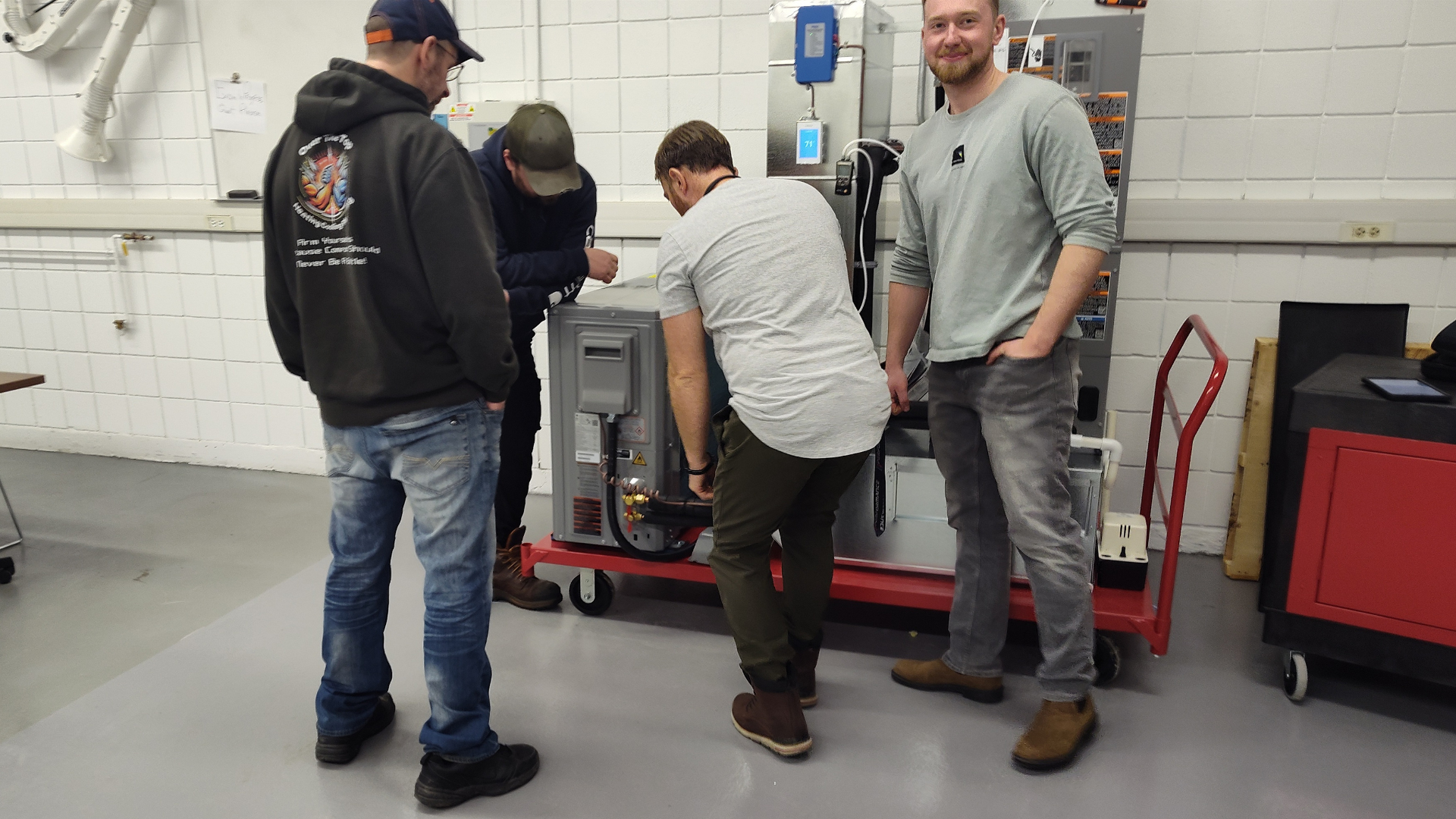
In addition to understanding the theory and design principles, the course also offers hands-on exercises on troubleshooting and installation. Compressors in heat pumps operate at higher pressures than those in air conditioners, making them more susceptible to failure due to workmanship issues. Small defects that would be acceptable in air-conditioning installations become system failures in heat pumps.
The course is led by both an experienced HVAC designer/installer and a NAIT instructor. This is a great combination that gives students practical, applicable knowledge.
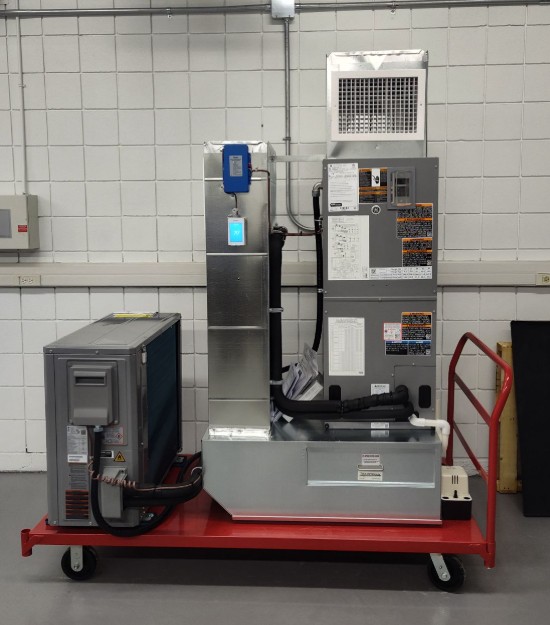
Portable Heat Pump Unit – Photo credit: Joseph Henke
Conclusion
- Heat pumps are critical to efficient space heating and cooling in buildings
- Incorporating more heat pumps into new and existing buildings across Alberta is an essential step toward reaching the province’s climate change goals.
- Heat pumps provide benefits for building tenants’ health and wellness and improve resilience to extreme heat.
- Heat pumps are complex and operate differently from furnaces and boilers.
- Upskilling the HVAC trades is essential to the adoption of heat pumps.
Interested in offering similar training?
If you are a post-secondary or training provider and would like to offer a similar training, please contact us.