
Authors: Amy Spark and Josh McAlpine
How a partnership between Four Winds and Alberta Ecotrust supported construction-ready retrofit planning in Indigenous communities
Building upgrades and retrofits can take years to advance from concept to implementation. Energy audits are usually the first step, helping communities understand how their buildings use energy and where improvements can be made. But without dedicated effort, it can be difficult to translate energy audits into funded, construction-ready projects.
A recent partnership between Four Winds & Associates and Alberta Ecotrust tackled these translation challenges by offering enhanced services to their participants.
The national Deep Retrofit Accelerator Initiative provides funding to 13 organizations that facilitate the development of deep retrofits in commercial, institutional, and multi-use residential buildings in Canada. There are two retrofit accelerators offered in Alberta: Four Winds & Associates and Alberta Ecotrust. Four Winds, in partnership with Simplify Energy, provides deep retrofit services, training and financial support specifically to Alberta’s Indigenous communities.
Project overview
Through a strategic partnership, Alberta Ecotrust and Four Winds worked to enhance retrofit readiness within Indigenous communities. Alberta Ecotrust served as the funding partner while Four Winds led the project’s delivery. All the work outlined below took place between January and March 2026, representing a large mobilization of resources within a short timeframe.
This project was designed to address a gap in the building improvement lifecycle. While technical assessments such as building condition reports and energy audits are routinely completed, there is often limited capacity and clarity required to translate these findings into funded, construction-ready projects.
To address this gap, Four Winds provided communities with three interconnected deliverables:
- Two-year subscriptions and onboarding support to the Awetza building management tool for 38 communities across Treaty 6, Treaty 7, and Treaty 8. This tool houses everything communities need related to their buildings in one centralized place.
- Pathway to Funding Readiness reports for 90 buildings, integrating two existing but traditionally disconnected data sources. These reports give communities a clear path forward when requesting funding.
- Piloting the development of one Construction-Ready Planning Brief, consolidating multiple layers of technical information into one document that the community can use for construction planning.
Awetza building management tool
Awetza is an Indigenous-led and owned online platform designed to support communities with their data. The software serves as a hub for Indigenous communities to store, manage and track their data through a user-friendly interface, all grounded in principles of data sovereignty. Four Winds and Awetza gathered, digitized, and organized data for 255 buildings across 38 organizations. As a result, these organizations now have a complete repository of information, including facility photos, equipment inventories, utility bills, energy models, and funding applications.
By pre-populating the data and providing structured onboarding and training, the project team removed a major barrier to adoption and enabled communities to begin using the platform immediately. Organizations can now interact with their building data and reports in a more accessible, visually structured format. This is particularly important in environments where staff turnover or limited internal capacity can result in loss of critical information over time.
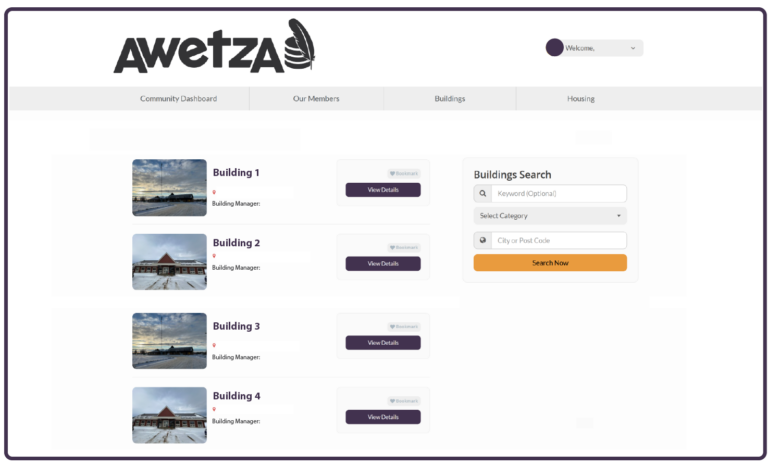
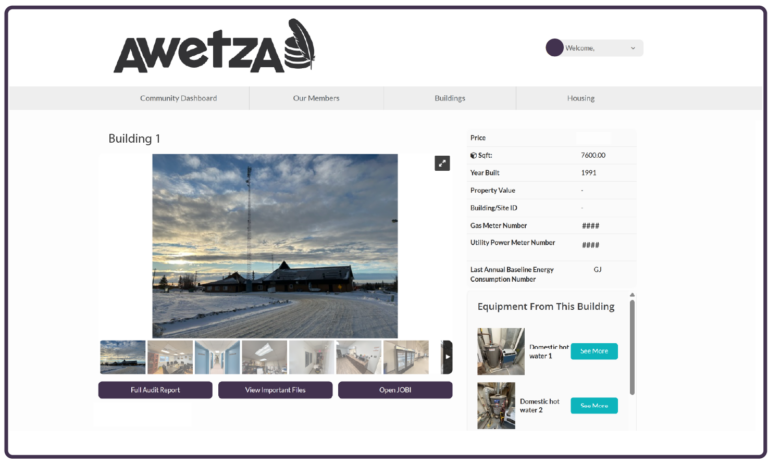
Images: Screenshots from Awetza tool.
Pathway to funding readiness reports
The Extended Asset Condition Reporting System Program (E-ACRS), funded through Indigenous Services Canada (ISC), arranges inspections of federally-funded infrastructure on First Nations lands, such as schools, administrative buildings, and recreational centres. E-ACRS reports are produced every three years to provide recommendations and cost estimates for repairing, replacing, or maintaining building systems. While technically valuable, their primary focus is on maintaining functionality rather than evaluating energy performance.
Many of these same buildings have also received energy audits through Four Winds’ Retrofit Accelerator program. The energy audits focus on identifying opportunities to improve building performance and reduce emissions.
The Pathways to Funding Readiness reports were developed to integrate these two reports into a unified framework that aligns with the ISC’s existing templates for project funding and evaluation. The significance of these reports lies in their ability to embed energy and emissions reduction projects within an existing framework, making them more likely to move forward.
Construction-ready planning brief
The final aspect of this project involved developing a construction-ready planning brief. The document consolidated multiple layers of technical information (including energy audit findings and preliminary engineering design work) into a single, unified document. The community has since used the brief to inform their procurement and construction planning, acting as a bridge between assessment and implementation.
Project impact and takeaways
This project emphasized the scale and complexity of infrastructure challenges faced by Indigenous communities. Building upgrades, retrofits and capital projects often require significant investment and can take multiple years to advance from concept to implementation. These timelines, combined with funding constraints, create barriers to progress and contribute to a backlog of infrastructure needs.
As a result, there is a strong need for tools that help prioritize projects, align funding opportunities, and reduce delays between assessment and execution. Furthermore, these tools and reports cannot exist in isolation. Alone, E-ACRS reports address functionality and energy audits address energy performance, but together, the Pathways to Funding Readiness report enhances each with the other, resulting in a better understanding of synergies and opportunities.
This project also reinforced that technical tools alone are insufficient without a relational approach. Relationships that respect community context, priorities, and decision-making processes are critical to advancing retrofits. Effective program delivery requires both technical rigour and relationship-based collaboration.
Lastly, there is a clear demand for solutions that directly serve Indigenous organizations and reduce dependence on external intermediaries. The success of Awetza and the Pathway to Funding Readiness reports shows that when tools are designed with this intent, they can strengthen internal capacity.
“We were honoured to be part of this important legacy project. The ability to provide guidance and support to communities that require this kind of support is at the heart of what we do, and it was a privilege to serve in that role alongside Alberta Ecotrust.”
– Dan Martel, Founder & President, Four Winds & Associates
Next steps
Alberta Ecotrust and Four Winds intend to keep working and learning together to enhance deep retrofit services for Indigenous communities. We will continue to share learnings along the way.
This blog is the first in our Alberta Ecotrust Retrofit Learning Series. Each month, we will publish a story about an innovative project or approach coming out of the Retrofit Accelerator. Do you have a story to share? Contact buildings@albertaecotrust.com to tell us about your project!