Author/Contributor: Circular Construction Canada, Telfer School of Management – University of Ottawa
Alberta Context: With a significant number of vacant office buildings in Alberta’s downtown cores, these communities require expanded options for affordable housing. Six of the eight case studies are located in Calgary and Edmonton. They feature retrofitting and repurposing projects, such as converting four vacant office towers into housing, turning a former hotel into supportive housing, and restoring a heritage utility building into a headquarters. Multiple projects used funding through the Downtown Calgary Development Incentive Program.
Summary:
Reusing existing buildings creates value, preserves embodied carbon, and offers a viable alternative to new construction. These eight case studies show how that has been done in Alberta and across Canada, from large office tower conversions to a single-family home envelope retrofit. They are part of a project to build a guideline and toolkit for adaptive reuse, funded by the Alberta Real Estate Foundation and Alberta Ecotrust Foundation.
Key findings:
- The Downtown Calgary Development Incentive Program cut conversion costs by nearly a third at The Cornerstone and offered $75/sq. ft. for Petrofina.
- Conversions can create family housing. Petrofina has 103 suites (52 three-bedroom), and The Cornerstone features 112 multi-bedroom units, with 45 rented 10–40% below market.
- Non-profit and Indigenous-led initiatives serve high-need groups. Neoma provides 82 units (rented at 60% below the market average), while Pimatisiwin supplies enhanced-care and supportive housing.
- Reuse prevents waste at shíshálh Nation by diverting ~1,000 tonnes of materials and saving ~230 tonnes of embodied carbon.
- Some projects have stacked municipal incentive programs, government funding, philanthropy, and developer capital.
The case studies:
- The Cornerstone (Calgary): Astra Group converted a former office building that had been almost entirely vacant for 10 years into over 100 apartments, ground-floor retail and commercial micro-units. The project earned BuiltGreen Gold.
- 800 Six West (Calgary): Astra Group is converting an office tower that was 80% vacant into over 200 residential suites and 4 commercial spaces on an $83 million budget, with at least 70% of units offered below market rate. It is Astra’s third successful downtown Calgary office conversion project.
- Petrofina (Calgary): Peoplefirst Developments with METAFOR converted a heritage office tower that was 80% vacant into 103 residential suites with commercial space. The purchase price was $7.2 million, and the conversion cost was $42.1 million, with a 30% Operational energy improvement over a code-equivalent new build.
- Neoma (Calgary): HomeSpace Society and Inn from the Cold converted the former Sierra Place office tower into 82 homes, including 10 for emergency and transitional family shelter, plus a food bank. The total cost was $30 million, and the conversion took only 12 months. This project was Canada’s first office-to-shelter conversion.
- PEER Retrofit (Canmore): HSS Design Build upgraded a 1990 single-family home with prefab wood fibre exterior panels, triple-pane windows and improved insulation and airtightness. The home reduced energy use by 23.4% and overall GHG emissions by 16.5%.
- EPCOR Water 1931 (Edmonton): EPCOR restored a 1931 building in the Rossdale complex which was vacant for about 10 years. Original windows, masonry, terrazzo floors and staircases were restored, and new insulation, roofing, mechanical systems and LED lighting were installed. By retaining the existing structure instead of building a new one, this project achieved roughly 25% cost savings and a 60% reduction in embodied carbon.
- Pimatisiwin (Edmonton): NiGiNan Housing Ventures turned the former “Sands Inn & Suites” into 50 shelter spaces, 6 enhanced-care suites and 54 supportive housing units, with cultural supports and basic clinical care. This project avoided ~443–626 tonnes of embodied carbon with an expected $1.08M/yr Social Return.
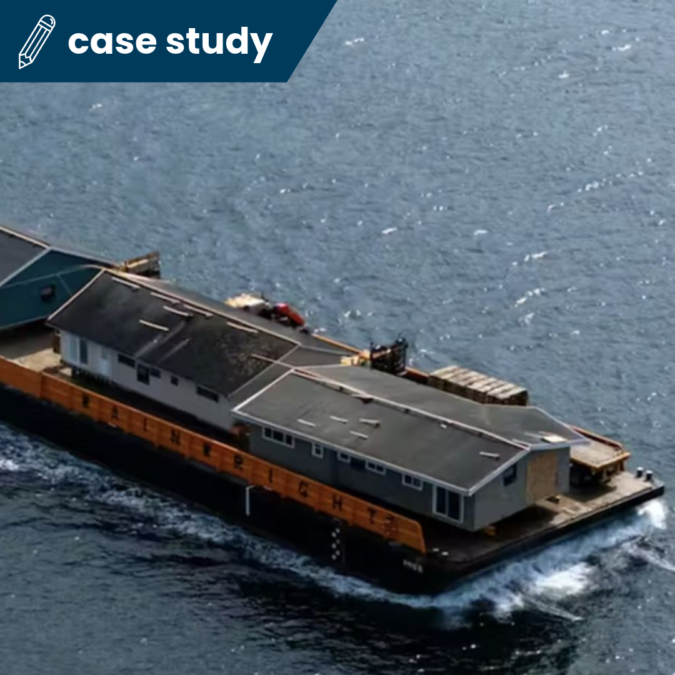
- shíshálh Nation (Port Moody to Selma Park, BC): 10 houses slated for demolition were moved by truck and barge and renovated into 17 below-market homes. Heat pumps, extra insulation and cedar shingles were added. This housing cost 20–40% less than comparable new construction. An estimated ~1000 tonnes of material was diverted from landfill, with an estimated ~230 tonnes of embodied carbon preserved.
Read the case studies to see how owners and developers are giving existing buildings a new lease on life.