Author/Contributor: Building Decarbonization Alliance / The Transition Accelerator
Alberta Context: This resource specifically addresses electricity grid emissions for Alberta’s heat pumps and breaks them down into total greenhouse gas (GHG) impact over a 16 year lifecycle.
Summary:
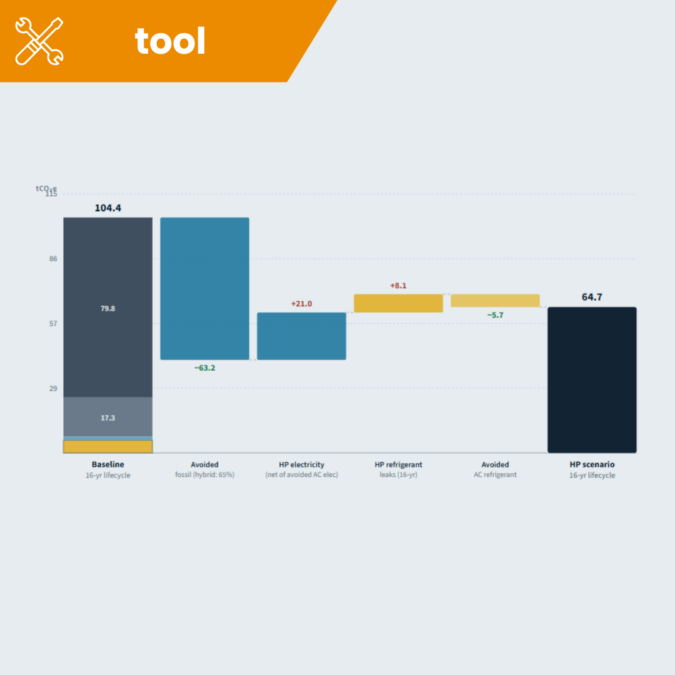
The Heat Pump Lifecycle Emissions Explorer is an interactive tool designed to evaluate the total greenhouse gas (GHG) impact of switching to a heat pump. The goal of the tool is to remove skepticism that refrigerant leaks (R-410A) erase electrification’s climate benefits.
Key Findings:
- In almost all cases, refrigerant leaks do not cancel out the climate benefits of switching to heat pumps.
- Even under a worst case scenario (high refrigerant leaks, emissions intensive grids, or methane leakage), heat pumps deliver substantial lifecycle GHG savings.
Features:
- Users can test assumptions by toggling a wide range of parameters informed by industry standards.
- Compare the heat pump against a natural gas furnace, heating oil furnace, or electric resistance baseboards.
- Select between full electric or hybrid heat pump configurations, adjustable heat pump heating load, and adjustable seasonal COP
- Choose the heat pump refrigerant options (R-410A, R-454B, R-32, or R-290). Users can toggle lifetime refrigerant loss scenarios between low, median and high.
- Test scenarios across different provincial grids (Québec, Ontario, Alberta) and choose between a static grid trajectory or a forecasting model.
- Toggle cooling counterfactuals (accounting for alternative A/C), adjust upstream methane leak rates, and switch between 100-year and 20-year GWP time horizons.
The explorer tool uses the Standard Total Equivalent Warming Impact approach, which calculates direct emissions (refrigerant leaks) and indirect emissions (energy use) to compare baseline systems with heat pump scenarios.
View the tool here.